

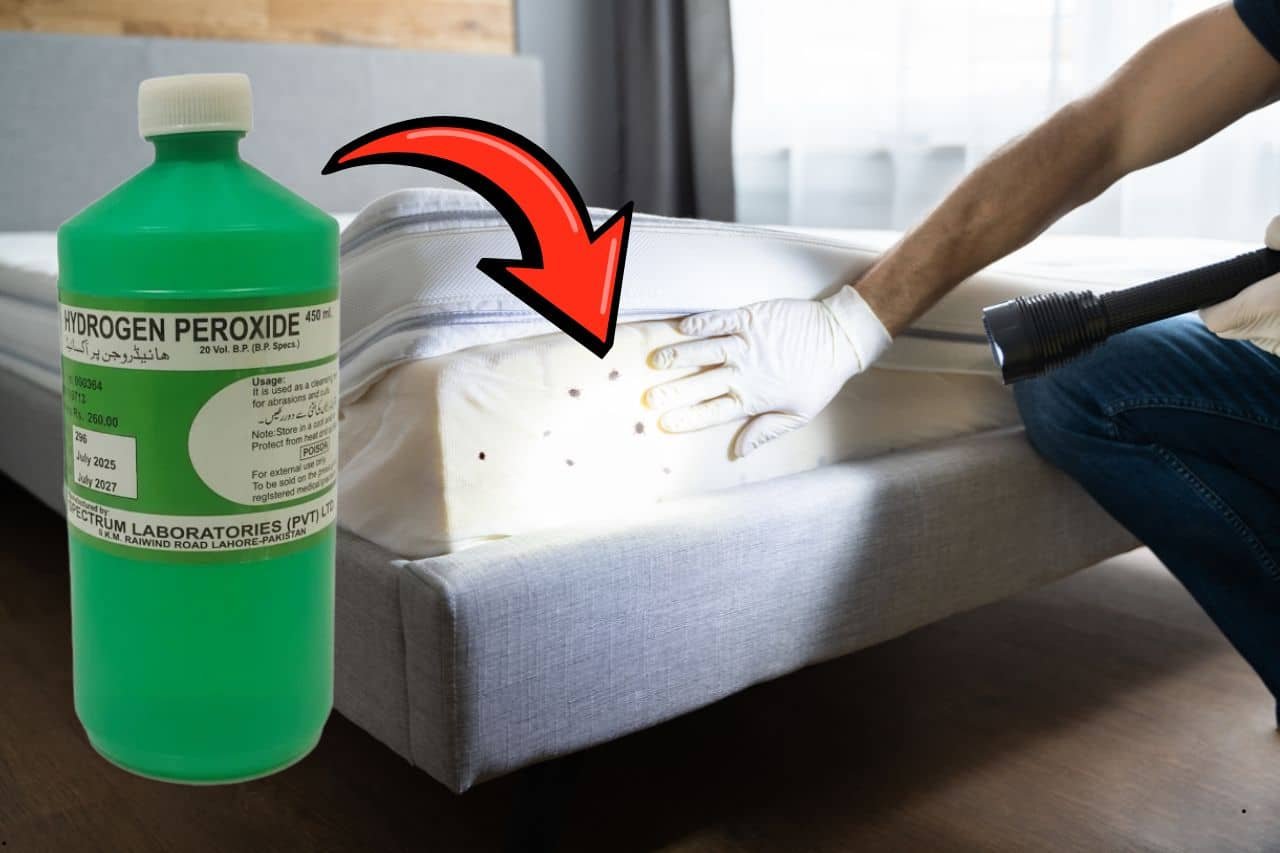
As soon as a single bed bug is spotted most of the people panic and immediately approach products that are already available under skin. Their first choice is always hydrogen peroxide as it is readily available and also a strong disinfectant which finely handle bacteria and viruses.
People assume on their own that it will also kill bed bugs. However, the answer is not so simple.
Technically Yes — Practically, Not Really
Normally, household products only have 3 percent hydrogen peroxide, which is actually not a strong enough dose to handle more than two bed bugs at a time.
This is practically not possible to kill bed bugs by simply spraying hydrogen peroxide on them, because they hide themselves in cracks, under the bed, gaps between walls, and deep inside the springs of the bed. So practically, it is impossible that through general spraying you can kill a whole infestation.
Warning: As you read now that concentration is the problem and assume in your own mind that you have to increase the concentration, let me tell you the consequences first. It can become dangerous for you, your home, materials, and surfaces as well, while causing little damage to bed bugs.
What If You Directly Spray on a Bed Bug? Do They Die?
Yes, the spray will come into contact with the outer layer of the bed bug, and it starts damaging the bed bug’s cells and tissues, which send signals to the nervous system, and it becomes damaged; at the end, the bed bug dies.
Fact: It means only direct contact can make hydrogen peroxide effective for bugs; otherwise, it is useless for bed bugs. Because a single bed bug can multiply into 1000 in just a few weeks.
If you want to know how fast bed bugs multiply, you can read my article How Fast Do Bed Bugs Multiply; it will give you some extra knowledge and also address your curiosity about Is It Possible to Only Have One Bed Bug?
Does It Work on Eggs?
The thing that makes hydrogen peroxide the most useless disinfectant for bed bugs is that they have zero effect on the eggs. Because the eggs are more resistant to pesticides and because of hydrogen peroxide’s limited potential, they are fully secure. So any disinfectant that can not kill the eggs can not be termed a full-fledged treatment of bed bugs.
Information: The U.S. Environmental Protection Agency (EPA) identified that many pesticide can not kill the eggs that is why they always says follow up treatment is compulsory after first pesticidal treatment of any insect.
What Chemical Does Scientific Research Recommend for Bed Bug Treatment?
The EPA encourages the use of certified and specific pesticides for bed bugs rather than merely relying on household items. The EPA lists some highly effective chemicals, which are:
- Pyrethroids
- Pyrethrins
- Desiccants
- Neonicotinoids
- Pyrroles
Note: EPA does not list hydrogen peroxide as a disinfectant to kill insects.
Some Other Treatments Recommended by EPA:
Other than these chemicals, EPA suggests:
- Professional heat treatment: For this you have to approach some professionals that are providing this service. In this, they raise the temperature of the room to above 118°F. This kills all the bugs and eggs, no matter how deep they are hiding. This is a foolproof treatment that will clear the entire bed bug infestation in just a single day.
- Professional pesticide treatment: Here, professionals mix different pesticides and insecticides with specific concentrations, spray them, and apply them using their own techniques. This process is also effective for eggs.
| Question | Answer |
|---|---|
| Can hydrogen peroxide kill bed bugs? | On direct contact |
| Is it effective for treating an infestation? | No |
| Does it kill bed bug eggs? | No |
| Does it leave residual protection? | No |
| Does it damage fabrics and surfaces? | Yes |
| What actually works? | Professional heat treatment or pesticide application |
Read Also:
